




Anasayfa > Kitap< Geri dönün
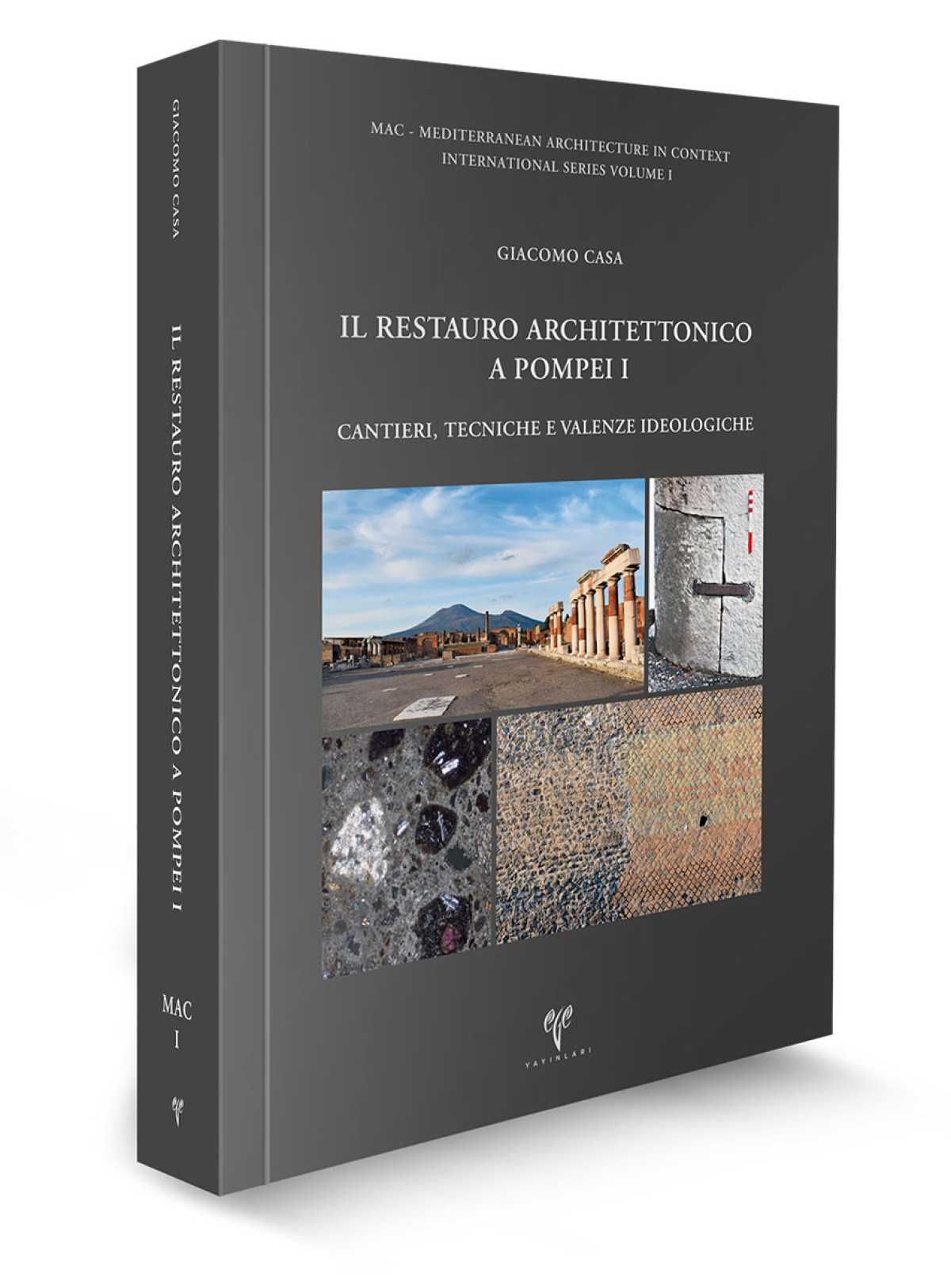
Daha ayrıntılı olarak görmek için ana resmin üzerinde fareyi hareket ettirin.
Il Restauro Architettonico a Pompei - I: Cantieri, Tecniche e Valenze Ideologiche
Yayınevi: Ege Yayınları
ISBN: 9786256212312
7.650,00 TL8.500,00 TL (KDV Dahil)
FİYATI DÜŞTÜ ! 10% oranında (850,00 TL) kazançlısınız.
Kargoya verilme süresi: 1 - 5 İş Günü
İlişkili Ürünler
 The Roman Empire : From the Etruscans to the Decline of the Roman Empire
 Pompeii : White Star Guides - Archaeology
 Women and Beauty in Pompeii
 Eroticism in Pompeii
 Gods and Heroes in Pompeii
 Hadrian And The Triumph Of Rome
Yazar: Giacomo Casa
Cilt tipi: Sert Kapak
What did it mean to restore an entire city in antiquity? And how did the public architectures of a Roman colony respond to a devastating event? In this groundbreaking study, Il restauro architettonico a Pompei I. Cantieri, tecniche e valenze ideologiche, Giacomo Casa offers the first comprehensive analysis of the architectural restoration in Pompeii that followed the catastrophic earthquake of 62 AD. Far from being a simple chronicle of repair activities, the book redefines restoration as a multi-layered cultural process, which not only rebuilds damaged structures but reaffirms systems of authority and reorients the urban landscape.
Structured in ten chapters and a final interpretive essay, the volume presents an in-depth investigation of the restoration works carried out in the Forum of Pompeii. The core of the study lies in the identification of five distinct meanings and functions of restoration in the Roman world: conservation, updating, technological innovation, reuse, and urban reconfiguration. Each of these aspects is explored through the analysis of the buildings facing on the public square. Casa challenges long-standing historiographical models, especially the narrative of a Pompeii in irreversible decline after the earthquake, by offering a radically different picture.
The volume’s methodological basis is represented by the painstaking analysis of masonry stratigraphic units, building techniques, archaeometric investigation of materials in collaboration with ISPCCNR, and the critical re-examination of excavation diaries. The solid documentation converges to build a robust interpretive framework, demonstrating that many monuments were not only restored but brough to a full functionality. Thus, the city appears as a complex, adaptive system engaged in a coordinated and meaningful reconstruction process, whose social, logistic, technological and political factors are brought to light. Richly illustrated and conceptually innovative, Casa’s book inaugurates the MAC Series.
MAC – Mediterranean Architecture in Context Series.
Editors-in-Chief: Marco Galli (Sapienza Università di Roma) – Tommaso Ismaelli (CNR-ISPC Consiglio Nazionale delle Ricerche, Istituto di Scienze del Patrimonio Culturale).
Scientific Board: Anna Anguissola (Università di Pisa); Sara Bozza (CNR-ISPC Consiglio Nazionale delle Ricerche, Istituto di Scienze del Patrimonio Culturale); Vassilis Evangelidis (Athena Research Center); Johannes Lipps (Johannes Gutenberg-University Mainz); Monica Livadiotti (Politecnico di Bari) Musa Kadıoğlu (Ankara Üniversitesi); Ursula Quatember (Technische Universität Berlin); Carlo Rescigno (Università della Campania Luigi Vanvitelli); Philip T. Stinson (University of Kansas); Elisavet P. Sioumpara (?.?.?.?. Acropolis Restoration Service); Monika Trümper (Freie Universität Berlin).
Editorial Board: Giacomo Casa (Sapienza Università di Roma); Luca Dal Monte (Sapienza Università di Roma).
MAC Mediterranean Architecture in Context International Series
MAC welcomes monographic studies, collective volumes, conference proceedings, and excavation and survey publications focused on the documentation, reconstruction, and interpretation of architecture within the ancient Mediterranean. The term Mediterranean should be understood not simply as a geographical indication, but as a dynamic cultural space where over the centuries connectivity and mobility have driven the development of architectural languages, experimenting with forms, knowledge, and technologies. The scientific and methodological foundation of the series lies in the necessity of addressing ancient architecture by considering the archaeological approach to contexts when reconstructing individual buildings or monumental complexes, entire urban sectors, or even broader “landscapes”.
Architecture must be analyzed within the context of local resources, cultures, and traditions, as well as the circulation of people, knowledge, and expertise across the Mediterranean. Whether examined through design, function, technique, materials, or decorative solutions, this approach highlights the interplay of social, symbolic, and technical dimensions. In this framework, context emphasizes diachrony, the contribution of archaeology to the reconstruction of built space, the importance of images and visual culture. The ancient city, as the primary setting for architecture, is of particular significance to the series, as well as the reconstruction of craft practices and social dynamics of the building sites.
STORIA DELLA RICERCA, OBIETTIVI E METODI
Storia della ricerca
Obiettivi
Metodologia
EDIFICIO DI EUMACHIA
Inquadramento storico-topografico
Portale
Portico
Stilobate
Elementi architettonici
Chalcidium
Stilobate
Elementi architettonici
Restauri di epoca moderna
Restauri post-62 d.C.
Modalita dei restauri
Facciata
Muri perimetrali
Criptoportico
Terminazione orientale del peristilio
Portico
Vasche di calce
Apparato decorativo statuario
Valutazioni conclusive
Trasformazioni successive al restauro post-62 d.C.
Ipotesi di restituzione architettonica
CD. TEMPIO DEL GENIUS AUGUSTI - TEMPIO DI VESPASIANO
Inquadramento storico-topografico
Restauri di epoca moderna
Restauri post-62 d.C.
Modalità dei restauri
Vestibolo
Corte interna
Tempio
Ambienti orientali
Valutazioni conclusive
Altare
Iscrizione di Mamia
Trasformazioni successive al restauro post-62 d.C.
Ipotesi di restituzione architettonica
MACELLUM
Inquadramento storico-topografico
Età sannitica
Età imperiale
Restauri di epoca moderna
Restauri post-62 d.C.
Modalità dei restauri
Lotti di cantiere 1-4: muri perimetrali
Lotti di cantiere 5-7: tabernae occidentali, settentrionali e meridionali
Lotto di cantiere 8: angolo nord-occidentale
Portico
Tholos
Apparato decorativo pavimentale, parietale e statuario
Vestibolo sul Foro
Stilobate
Elementi architettonici
Trasformazioni successive alla ricostruzione post-62 d.C.
Ipotesi di restituzione architettonica
CD. SANTUARIO DEI LARI PUBBLICI - EDIFICIO DEL CULTO IMPERIALE
Inquadramento storico-topografico
Restauri di epoca moderna
Restauri post-62 d.C.
Modalità dei restauri
Ipotesi di restituzione architettonica
SANTUARIO DI APOLLO
Inquadramento storico-topografico
Età arcaica
Età sannitica e tardo-repubblicana
Tempio
Portico
Stilobate
Elementi architettonici
Muro a pilastri
Età imperiale
Restauri di epoca moderna
Restauri post-62 d.C.
Modalità dei restauri
Muri perimetrali
Tempio
Portico
Apparato decorativo statuario
Ipotesi di restituzione architettonica
EDIFICI MUNICIPALI
Inquadramento storico-topografico
Età sannitica
Età imperiale
Restauri di epoca moderna
Restauri post-62 d.C.
Modalit. dei restauri
Edificio orientale
Edificio centrale
Edificio occidentale
Valutazioni conclusive
Ipotesi di restituzione architettonica
CD. COMITIUM - DIRIBITORIUM
Inquadramento storico-topografico
Restauri di epoca moderna
Restauri post-62 d.C.
Modalit. dei restauri
Ipotesi di restituzione architettonica
PORTICI DEL FORO
Inquadramento storico-topografico
Età sannitica
Età imperiale
Stilobate
Elementi architettonici
Restauri di epoca moderna
ARCHI ONORARI
Inquadramento storico-topografico
Restauri di epoca moderna
Restauri post-62 d.C.
Modalità dei restauri
Cd. Arco di Germanico
Cd. Arco di Tiberio
Trasformazioni successive alla ricostruzione post-62 d.C.
Ipotesi di restituzione architettonica
Cd. Arco di Tiberio
Cd. Arco di Germanico
IL RESTAURO ARCHITETTONICO A POMPEI: INTERPRETAZIONE DI UN FENOMENO
Le ragioni dei restauri e valutazione dei danni
Gli edifici non restaurati: Basilica e Tempio di Giove
Le evidenze architettoniche di pi. terremoti dopo il 62 d.C.
Il restauro come misura conservativa, aggiornamento e innovazione tecnologica
Il restauro come misura conservativa
Il restauro come aggiornamento
Il restauro come innovazione tecnologica
Gerarchizzazione delle pietre costruttive
Nuove tecniche di riparazione
Nuovi materiali costruttivi
Sviluppo di una cultura sismica locale
Il restauro come reimpiego
Il restauro come ripensamento urbanistico
Il restauro e l’autorit.: coordinamento e finanziamento dei lavori di ricostruzione del Foro di Pompei
ABBREVIAZIONI BIBLIOGRAFICHE
SUMMARY
TAVOLE
İtalyanca - İngilizce özet ile
2025
468 Sayfa
24,50 x 34 cm
